
Multi-Lane Granule Stick Pack Machine
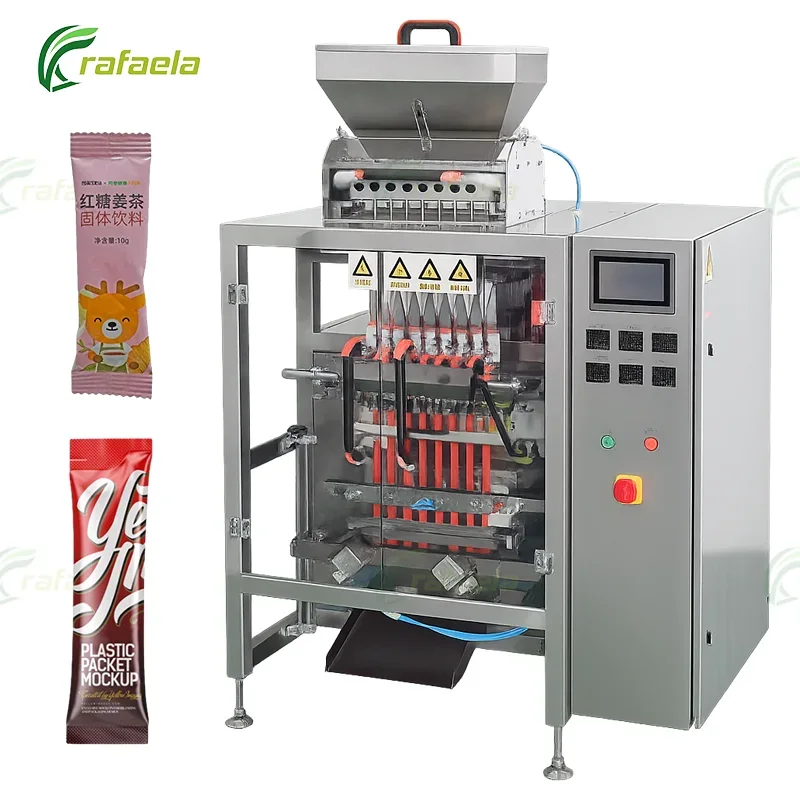
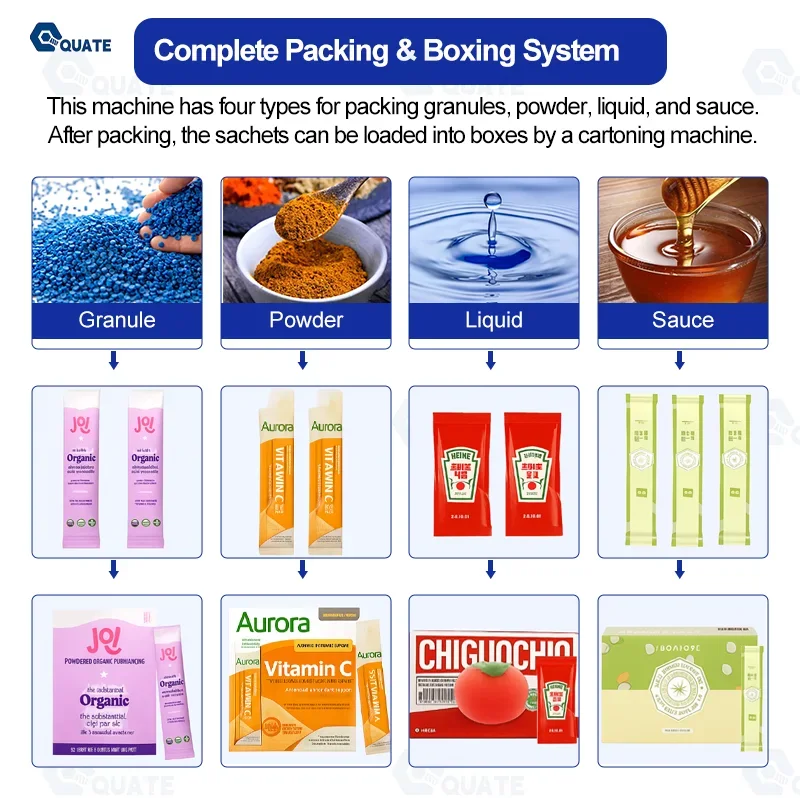
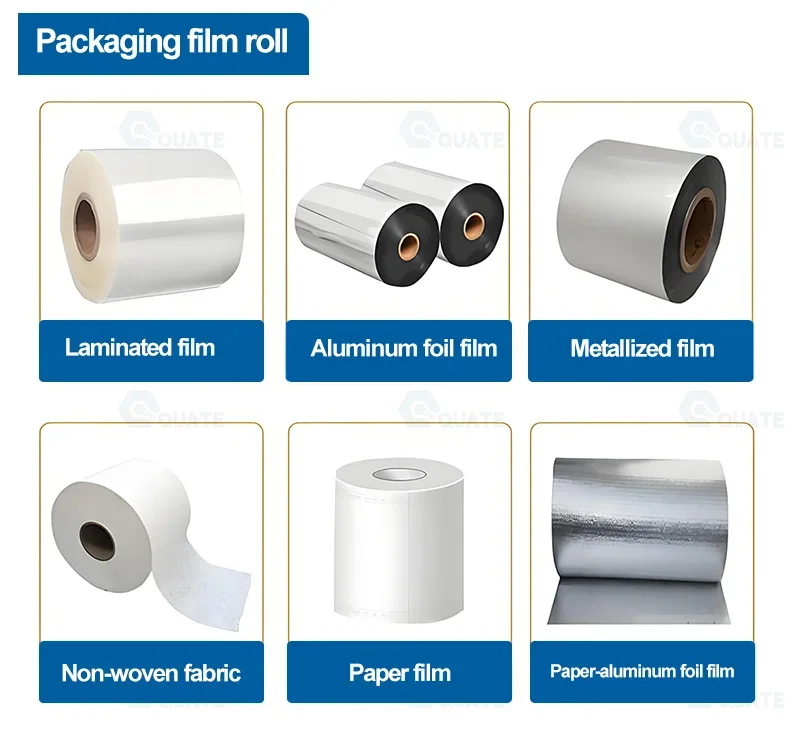
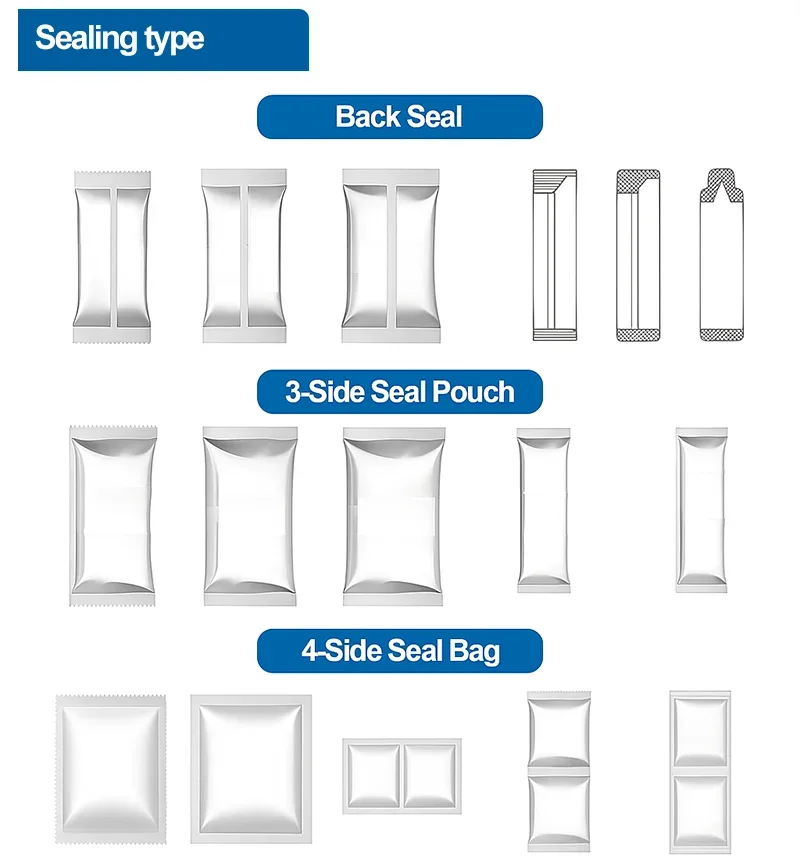
This multi-lane granule stick pack machine measures, fills, forms, seals, and cuts several narrow sachets simultaneously. It is suitable for sugar, salt, coffee granules, seasonings, drink crystals, desiccants, and other compatible free-flowing materials. Different lane quantities, film widths, bag dimensions, and dosing systems are available, allowing manufacturers to select a configuration according to the product, portion size, required output, and available production space.
Product Overview
This multi-lane granule stick pack machine is designed for producing multiple narrow back-sealed sachets from roll-fed packaging film. Depending on the selected model, the machine can be configured with different lane quantities to meet various package widths and production requirements.
Granular material is supplied to the upper feeding and dosing section, where a volumetric cup or compatible electronic weighing system measures the required portion for each lane. Packaging film is unwound, divided, guided through the forming units, and pulled downward according to the selected bag length. Each lane then completes product filling, longitudinal back sealing, horizontal sealing, cutting, and finished-sachet discharge.
The machine is suitable for sugar processors, condiment factories, coffee and beverage manufacturers, food ingredient suppliers, desiccant producers, and contract packaging companies requiring high-volume small sachets.
Its modular multi-lane structure enables customers to choose the lane quantity according to sachet width, film width, dosing method, target output, and product characteristics. Final suitability depends on particle size, bulk density, flowability, moisture content, dose weight, film structure, and required cutting style.
Applications
This machine is suitable for dry, free-flowing granular materials that can be measured consistently and discharged through narrow filling tubes. The selected dosing system should be matched to product density, particle uniformity, target dose, and required accuracy.
This machine is suitable for:
- White sugar
- Granulated sugar
- Brown sugar granules
- Salt
- Coffee granules
- Instant beverage granules
- Seasoning granules
- Monosodium glutamate
- Granulated sweeteners
- Tea granules
- Citric acid granules
- Desiccant granules
- Small seeds
- Other free-flowing granular products
A material test is recommended for sticky granules, oily products, fragile particles, mixed materials with inconsistent density, high-moisture products, excessive powder, or products that may bridge inside the hopper.
Main Features
1. Flexible Multi-Lane Configuration
Different machine widths support multiple lane quantities, allowing the packaging system to be selected according to sachet width, output requirement, and available film width.
2. Parallel Sachet Production
All configured lanes perform dosing, filling, forming, sealing, and cutting simultaneously, increasing total output without installing several separate packaging machines.
3. Multiple Dosing Options
A volumetric cup system or compatible electronic weighing system can be selected according to the product’s flowability, bulk density, portion size, and accuracy requirement.
4. Narrow Back-Sealed Sachets
Each lane produces a slim sachet with a longitudinal back seal, suitable for single-use portions of sugar, salt, coffee, seasonings, drink granules, and desiccants.
5. Servo Film-Pulling System
The servo-controlled film drive advances the packaging material according to the selected bag length and coordinates film movement across the packaging lanes.
6. Adjustable Bag Length
The documented series supports adjustable bag lengths, while sachet width is determined by the selected model, lane arrangement, and forming components.
7. PLC and Touch-Screen Control
The control system coordinates dosing, film feeding, temperature control, sealing, and cutting while allowing operators to manage relevant production settings.
8. Printed-Film Registration
A color-mark tracking system can align printed film graphics with the sealing and cutting positions when properly designed registration marks are provided.
9. Multiple Cutting Styles
Straight cutting, zigzag cutting, round cutting, and die-cut formats can be selected according to the required sachet appearance and opening method.
10. Auxiliary Equipment Connection
The machine can be combined with a material feeder and finished-sachet conveyor according to the production layout and material-loading requirements.
The specific four-lane quotation confirms PLC control, touch-screen operation, servo driving, temperature control, pneumatic sealing components, and film-position sensors, which support the documented working process.
Working Principle
Granular product is supplied to the upper hopper manually or through a separate feeding system. The material is distributed across the configured dosing lanes, where each volumetric cup or weighing unit prepares the required portion.
Packaging film is unwound from the roll and guided through the film-tracking and splitting system. The film is divided according to the selected lane arrangement and transferred to the individual bag-forming units. A servo-controlled mechanism pulls the film downward to the preset length.
Each forming unit shapes the film around its filling tube. The longitudinal sealing section produces the back seal, and the measured product enters the partially formed sachet. Horizontal sealing then closes the sachet ends before the cutting system separates or shapes the completed packages.
Finished sachets fall from the machine for collection or transfer by an optional conveyor.
Process Flow:
Material Loading → Multi-Lane Distribution → Dosing → Film Unwinding → Film Splitting → Sachet Forming → Filling → Back Sealing → Horizontal Sealing → Cutting → Discharge
Machine Details
1. Material Feeding Hopper
The upper hopper receives granular product and maintains a supply to the dosing section. Stable material level supports more consistent dosing across all active lanes.
2. Multi-Lane Dosing System
Each lane has a corresponding dosing path. Volumetric cups or weighing units measure and release the required portions into the filling tubes.
3. Film Unwinding Assembly
The roll holder and guide rollers supply packaging film continuously and maintain stable film movement toward the splitting and forming sections.
4. Film Alignment System
The film-guiding and correction structure helps maintain the correct lateral position while the material travels through the multi-lane packaging process.
5. Servo Film-Pulling Mechanism
The servo drive advances the film according to the preset sachet length and synchronizes film movement with the sealing and cutting cycle.
6. Multi-Lane Bag Formers
The forming units convert the divided film into several narrow sachet lanes and guide each film section around its corresponding filling tube.
7. Back-Sealing Units
Each lane includes a longitudinal sealing position that closes the rear seam after the film has been shaped around the forming tube.
8. Horizontal Sealing Section
The horizontal sealing mechanism closes the top and bottom edges of the sachets and separates consecutive filling cycles.
9. Cutting System
The cutting section produces the selected sachet edge style, including straight, zigzag, rounded, or die-cut formats where configured.
10. Touch-Screen Control Panel
The operator interface provides access to production settings, film length, temperature, operating speed, alarms, and machine start or stop controls.
Technical Parameters
| Parameter | Specification |
|---|---|
| Model | CY300BK / CY600BK / CY900BK |
| Lane Quantity | 2–4 lanes / 3–10 lanes / 4–16 lanes |
| Suitable Materials | Sugar, salt, seasonings, coffee granules, desiccants, and compatible free-flowing granules |
| Packing Speed | Approximately 30–50 bags per lane/min |
| Dosing Method | Volumetric cup or electronic weighing system, depending on configuration |
| Bag Size | Width: 17–70 / 17–95 / 17–105 mm; Length: 50–180 mm |
| Sealing Type | Back seal |
| Maximum Film Width | 300 / 600 / 900 mm |
| Power Supply / Rated Power | AC 220 V, 50 Hz / 3.5 / 5.5 / 7.5 kW |
| Machine Dimensions / Weight | 1800 × 1120 × 3000 mm, about 400 kg / 1800 × 1430 × 3020 mm, about 600 kg / 1810 × 1740 × 3100 mm, about 950 kg |
Packaging & Shipping
The final packing method, shipping dimensions, gross weight, and number of wooden cases depend on the selected model, lane quantity, dosing system, feeder, finished-product conveyor, and other accessories.
Before shipment, the machine should be tested using the buyer’s approved material, target dose, packaging film, sachet dimensions, printed artwork, cutting style, and required lane configuration. The dosing units, servo film drive, color-mark tracking, sealing temperatures, cutting positions, and control system should be checked against the confirmed order.
The specific quotation confirms that export wooden-case packing can be included, while the feeder and finished-product conveyor are listed as separate equipment.
Final export packing dimensions and gross weights should be confirmed after the complete selected configuration is assembled and packed.
FAQ
Q1: How many packaging lanes are available?
The series supports different lane ranges according to machine width. Available configurations include 2–4 lanes, 3–10 lanes, and 4–16 lanes. The final lane quantity depends on sachet width, film width, product characteristics, and required output.
Q2: How is the total production speed calculated?
The documented speed is approximately 30–50 bags per lane per minute. Total machine output depends on the number of active lanes, product flowability, portion size, film performance, bag length, sealing time, and actual operating settings.
Q3: What dosing system should be selected?
Volumetric cups are suitable for products with stable bulk density and consistent granule size. An electronic weighing system may be selected when the material characteristics or accuracy requirement make direct weight measurement more appropriate.
Q4: Can the machine use different sachet widths?
Different sachet widths can be produced within the supported range, but width is determined by the selected forming parts and lane arrangement. Changing width may require different bag formers, film splitting positions, sealing components, or lane quantities.
Q5: What information is required before ordering?
Please provide the product name, particle size, bulk density, target weight per sachet, sachet width and length, required lane quantity, expected output, film structure, film thickness, roll width, artwork, cutting style, and local power supply.
Send Inquiry
Share your product, material, bag size and capacity requirements. RafaelaPack will prepare a suitable packaging machine recommendation.